IMPORTANT DISCLOSURE: As an Amazon Associate I earn from qualifying purchases. This means if you click on an Amazon link and make a purchase, I may receive a small commission at no additional cost to you.


As an Amazon Associate, I earn from qualifying purchases.


Why Resistance Loop Bands Have Become Essential Training Tools
The fitness landscape in American homes has shifted dramatically over the past decade. More people are discovering that effective strength training, mobility work, and rehabilitation exercises do not require expensive gym memberships or bulky equipment taking over living spaces. Resistance loop bands represent this evolution perfectly—they deliver genuine training benefits in a format that fits seamlessly into modern lifestyles.
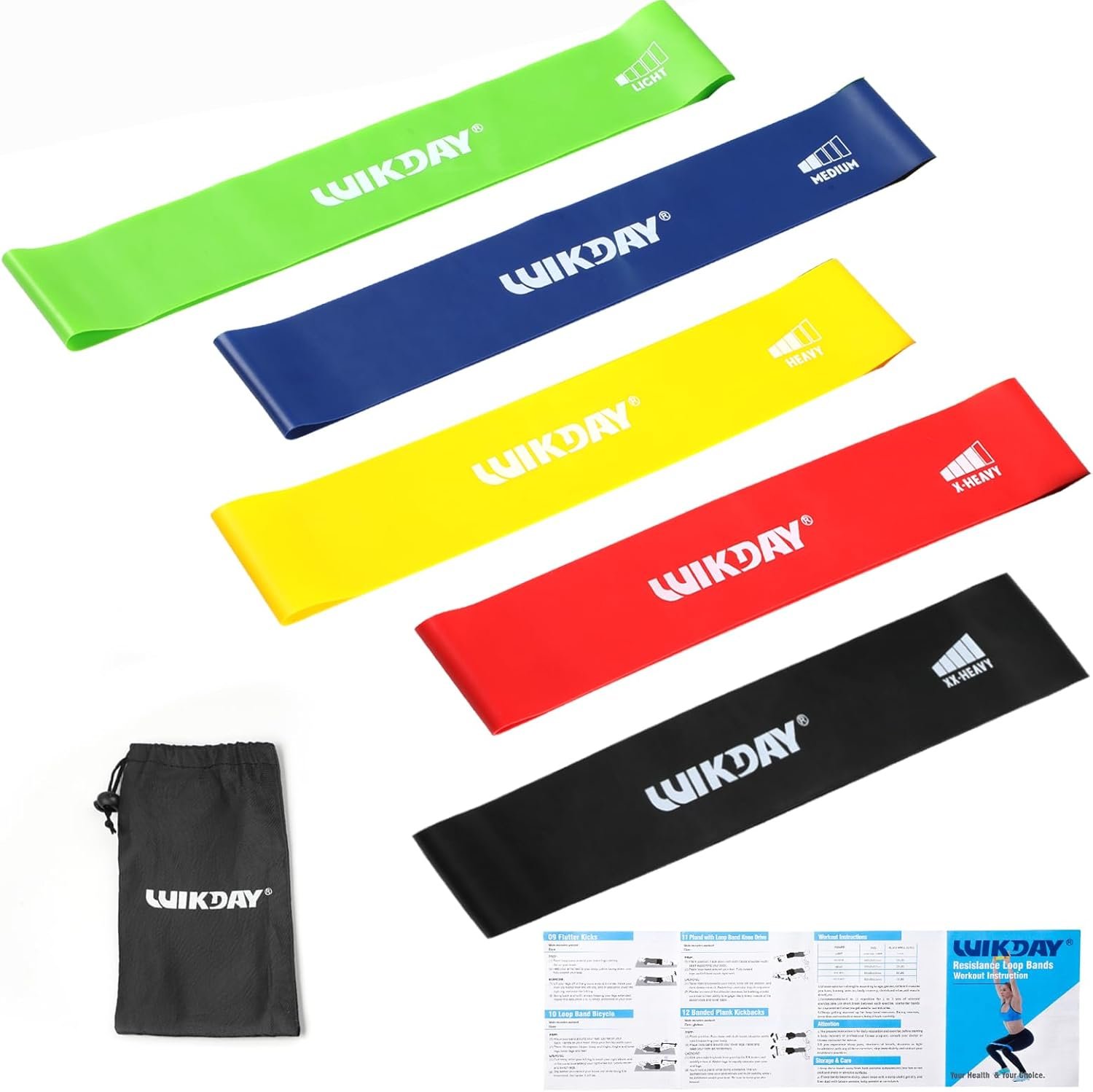
The WIKDAY Resistance Loop Bands Set brings together the core elements that make loop bands valuable for serious training. This five-piece set addresses the fundamental question many fitness enthusiasts ask: how can I build strength, improve mobility, and maintain consistent training regardless of where I am or what equipment I have access to?
Unlike resistance tubes with handles or therapy bands that require tying, loop bands form complete circles. This closed-loop design creates unique training possibilities. You can step into them for lower body work, wrap them around fixed objects for pulling exercises, or position them around limbs for activation drills. The continuous loop eliminates weak points found in bands with attachment mechanisms, distributing tension evenly throughout the band.
Understanding the Five-Level Progressive System
One of the most important features of this resistance loop bands set is the inclusion of five distinct resistance levels. Each band measures twelve inches in length and five inches in width when laid flat, but they differ in thickness. This thickness variation creates the resistance progression that allows the set to serve users from beginner through advanced fitness levels.
Why Progressive Resistance Matters
Your muscles adapt to training stress through a principle called progressive overload. When you consistently challenge your muscles with resistance, they respond by becoming stronger. However, this adaptation means that the resistance that challenged you last month may feel easy today. Without progression, your training plateaus and improvements stop.
The five-band system in this set provides built-in progression without requiring you to purchase additional equipment as you advance. You start with lighter bands that allow you to master movement patterns with proper form. As those movements become easier, you progress to thicker bands with greater resistance. This approach supports long-term fitness development rather than providing only short-term challenge.
Practical Application of Multiple Resistance Levels
Different muscle groups and exercises require different resistance levels even within the same workout. Your gluteal muscles, being among the largest and strongest in your body, can handle significantly more resistance than your rotator cuff muscles. Having five bands available means you can match resistance to each exercise rather than compromising by using one band for everything.
Consider a typical lower body and core workout. You might use the heaviest band for hip thrusts and glute bridges, where your posterior chain muscles can generate substantial force. For lateral band walks targeting hip abductors, you might drop to a medium resistance band. When you move to clamshells focusing on smaller stabilizer muscles, a lighter band provides appropriate challenge without forcing compensation patterns.
This flexibility within a single training session prevents you from being either under-challenged on strong movements or over-stressed on exercises requiring precision and control.
Training Tip: Band Stacking for Advanced Users
As you advance, you can combine multiple bands simultaneously to create resistance levels beyond what any single band offers. Two bands positioned together effectively double the resistance, allowing experienced users to continue progressing without needing heavier equipment. This technique is particularly valuable for exercises like banded squats and deadlift variations where you may outgrow single-band resistance.
Natural Rubber Construction: Why Material Quality Matters
The bands in this set are constructed from natural rubber, a material choice that significantly impacts both performance and longevity. Understanding why natural rubber matters helps you appreciate what you are working with and how to maintain these bands properly.
Elasticity and Resistance Consistency
Natural rubber possesses exceptional elastic properties. When you stretch a natural rubber band, it provides smooth, consistent resistance throughout the range of motion. Synthetic alternatives often feel different at various stretch points, creating inconsistent tension that can affect exercise form and muscle activation patterns.
This consistency matters more than you might initially think. During a set of banded squats, for example, you want predictable resistance as you descend and ascend. If the band suddenly increases resistance at certain points, it can throw off your balance or cause you to compensate with poor movement mechanics. Natural rubber delivers the uniform feel that supports proper training technique.
Durability Through Repeated Stretching Cycles
Resistance bands undergo substantial stress during normal use. Each repetition of an exercise stretches the band, sometimes to several times its resting length, then allows it to contract back. Over weeks and months, this repeated stretching can degrade lower-quality materials, causing them to lose elasticity, develop weak spots, or eventually snap.
Natural rubber maintains its integrity through thousands of stretch cycles when used appropriately. The material memory in quality natural rubber allows it to return to its original shape after stretching rather than remaining elongated or developing saggy sections that provide reduced resistance.
Care Considerations for Natural Rubber
While natural rubber excels in performance characteristics, it does require some basic care to maximize its lifespan. Direct sunlight exposure degrades natural rubber over time, breaking down the molecular structure and causing the material to become brittle. Similarly, exposure to extreme heat accelerates deterioration.
For these reasons, store your resistance loop bands indoors away from windows where direct sunlight hits. Keep them in the included carry bag when not in use, and avoid leaving them in hot cars or direct sunlight during outdoor workouts. After workouts, wipe bands clean if they have come into contact with sweat or dirt, then allow them to air dry before storage.
These simple maintenance practices ensure your bands maintain their resistance properties and structural integrity through years of regular training.
The Complete Muscle Groups You Can Target
One question many people have when considering resistance bands is whether they can truly replace or supplement free weights for comprehensive muscle development. The answer depends on understanding how to apply bands effectively across different movement patterns and muscle groups.
Lower Body Training Applications
Loop bands excel at lower body training, particularly for glute development, hip strengthening, and leg activation work. The closed-loop design allows you to position bands around your thighs, just above knees, or around ankles depending on the exercise and target muscles.
Glute-focused exercises form one of the primary use cases for loop bands. Exercises like banded glute bridges, hip thrusts, lateral walks, and clamshells create significant glute activation. The constant tension from band resistance throughout movement ranges stimulates muscle fibers differently than traditional weight training, making bands valuable even for those who also use free weights.
Quadriceps and hamstring work becomes accessible through exercises like banded squats, Bulgarian split squats, and leg extensions when the band is anchored properly. While these movements might not replace heavy barbell work for maximum strength development, they provide legitimate training stimulus, particularly for muscular endurance and movement pattern practice.
Hip stabilizers and abductors respond exceptionally well to band training. These smaller muscle groups around your hips play crucial roles in knee health, balance, and athletic performance, yet they are often undertrained in conventional gym programs. Exercises like lateral walks, fire hydrants, and clamshells specifically target these areas with appropriate resistance levels.
Upper Body and Core Integration
While loop bands are particularly popular for lower body training, they also facilitate effective upper body and core exercises when used creatively. The bands can be secured around stable objects, stepped on for anchoring, or held in specific positions to create resistance for various movement patterns.
Shoulder and back exercises include movements like banded rows, face pulls, and shoulder dislocations (a mobility drill, not an injury). By securing the band and pulling against it, you create similar movement patterns to cable machine exercises found in traditional gyms.
Arm training is possible through exercises like bicep curls performed by stepping on the band and curling against resistance, or tricep extensions by securing the band overhead and pressing downward. While these may not provide the same maximum resistance as heavy dumbbells, they effectively stimulate muscles and work well in high-repetition training approaches.
Core stability work benefits from band resistance during exercises like anti-rotation presses, pallof presses, and standing core twists. The bands create pulling forces your core must resist, building functional strength that translates to everyday activities and athletic movements.
Sample Full-Body Loop Band Workout
Lower Body Circuit:
- Banded Squats – 15 repetitions
- Lateral Band Walks – 10 steps each direction
- Single-Leg Glute Bridges – 12 repetitions per leg
- Clamshells – 15 repetitions per side
Upper Body & Core:
- Banded Rows – 15 repetitions
- Standing Chest Press – 12 repetitions
- Pallof Press – 10 repetitions per side
- Overhead Tricep Extensions – 15 repetitions
Perform 3 rounds of this circuit with 60 seconds rest between rounds for a complete thirty-minute workout requiring only your resistance bands.
Physical Therapy and Rehabilitation Applications
Beyond fitness training, resistance loop bands serve important roles in physical therapy and rehabilitation settings. Understanding these applications helps illustrate why these simple tools have gained such widespread professional acceptance.
Controlled Progressive Loading
One of the primary challenges in rehabilitation is providing appropriate resistance that strengthens recovering tissues without overloading them. Free weights create consistent gravitational resistance, but this can be either too much or too little depending on the angle and position of movement.
Resistance bands provide variable resistance based on stretch distance. Early in the movement when joints may be more vulnerable, resistance remains lighter. As you move through ranges where tissues are typically stronger, resistance increases. This natural resistance curve often matches human strength curves better than fixed weights, making bands ideal for careful progression in rehabilitation protocols.
Rotator Cuff and Shoulder Rehabilitation
Shoulder injuries are among the most common reasons people work with physical therapists. The shoulder joint relies heavily on small stabilizer muscles within the rotator cuff. These muscles require specific strengthening exercises performed with light resistance and high control.
Loop bands provide perfect resistance levels for rotator cuff exercises. Movements like external rotations, internal rotations, and scaption (a specific shoulder raise angle) effectively strengthen these muscles when performed with appropriate band resistance. The ability to start with very light bands and progress gradually allows safe rehabilitation progression.
Knee and Hip Stability Work
Many knee problems stem not from the knee joint itself but from weakness in hip stabilizer muscles. When hip abductors and external rotators are weak, the femur (thigh bone) rotates inward during activities like walking, running, or squatting. This internal rotation creates stress on knee structures, potentially leading to pain and injury.
Physical therapists frequently prescribe exercises like lateral band walks, clamshells, and monster walks specifically to strengthen hip stabilizers. These movements are difficult to replicate with traditional gym equipment, but they are perfectly suited to loop band resistance. The bands provide just enough resistance to strengthen these muscles without creating the joint loading that might aggravate existing knee issues.
Post-Surgical Progression
Following surgeries such as ACL reconstruction, rotator cuff repair, or hip replacement, patients move through carefully structured rehabilitation phases. Early phases focus on regaining range of motion, then progress to strengthening once tissues have healed sufficiently.
Loop bands fit naturally into these progression schemes. Light bands introduce gentle resistance during early strengthening phases. As healing progresses, patients advance to thicker bands providing greater challenge. The graduated resistance system in a five-band set perfectly supports this progression from early rehabilitation through return to full activity.
Portability: Training Wherever Life Takes You
The practical advantage of resistance loop bands extends beyond their training effectiveness. The complete portability of this five-band set fundamentally changes how you approach fitness consistency.
Travel Fitness Without Compromise
Business travel, vacations, and other trips away from home traditionally disrupt training routines. Hotel gyms vary dramatically in equipment quality and availability. Many have limited free weights, outdated machines, or operate under restricted hours that conflict with your schedule.
With resistance bands in your luggage, your training capabilities travel with you. The included carry bag easily fits into carry-on luggage or a gym bag. The total weight of all five bands combined measures less than two pounds, making them completely practical for any type of travel.
In your hotel room, you have immediate access to a complete resistance training setup. No need to scout gym locations, pay day fees, or adjust workout timing around facility hours. Early morning or late evening training sessions become possible regardless of location. This convenience dramatically increases the likelihood you will maintain training consistency during travel periods.
Outdoor Training Options
Weather permitting, resistance bands open possibilities for outdoor training in parks, backyards, or beachside locations. Unlike equipment requiring power sources or stable platforms, bands need only your body and occasionally a secure anchor point like a tree, fence post, or park bench.
Outdoor band training combines physical exercise with fresh air and natural surroundings, which research consistently shows benefits both physical and mental wellbeing. The change of environment can also reinvigorate training motivation when indoor workouts become monotonous.
Office and Break-Time Fitness
For those working from home or in office environments, resistance bands enable quick exercise breaks without requiring shower and clothing changes. You can perform a ten-minute band workout during lunch, completing enough volume to maintain strength and counteract hours of sitting, then immediately return to work.
These micro-workouts throughout the day accumulate meaningful training volume while also providing mental breaks that often improve focus and productivity. The bands store discretely in a desk drawer or cabinet, ready whenever you want to move.
The Instruction Manual: Why Guidance Matters
This resistance loop bands set includes an instruction manual with illustrated exercises. While this might seem like a minor addition, it actually addresses one of the most significant barriers people face when starting resistance band training: uncertainty about how to use them effectively.
Learning Proper Form and Technique
Resistance bands behave differently than free weights or machines. They do not rely on gravity, which means exercise setup and positioning matters tremendously. Small changes in band placement, stance width, or body angle can completely alter which muscles receive training stimulus.
The included manual provides visual references showing correct positioning for various exercises. These illustrations help you understand where to place bands on your body, how to secure them when needed, and what postures create effective resistance angles. This guidance proves particularly valuable for beginners who might otherwise spend weeks experimenting or risk developing improper movement patterns.
Exercise Variety and Progression Ideas
Many people purchase resistance bands with enthusiasm but quickly run out of exercise ideas, defaulting to the same few movements repeatedly. This limited approach restricts results and makes training boring, increasing the likelihood you will abandon the bands in a closet.
The instruction manual introduces exercise variety you might not discover independently. It typically includes movements for different muscle groups and training goals, providing a foundation you can build upon as you gain experience. Having these references prevents the common pattern of initial excitement followed by declining use as novelty fades.
Building Structured Workouts
Random exercises performed without structure produce random results. Effective training requires thoughtful organization of exercises, sets, repetitions, and rest periods based on your specific goals.
While you might eventually develop this programming knowledge through experience, the instruction manual gives you starting templates. It might suggest workout structures like circuits, straight sets, or interval formats. These templates provide frameworks you can follow immediately while learning training principles that will eventually allow you to create customized programs.
⚠️ Safety Reminders for Band Training
- Inspect bands before each use – Look for any tears, thin spots, or damage that could cause the band to snap during exercise
- Never release bands under tension – Always control the return to starting position; allowing bands to snap back can cause injury
- Secure anchor points properly – When wrapping bands around objects, ensure they cannot slip or pull loose during exercise
- Start with lighter resistance – Master movement patterns with easy bands before progressing to heavier resistance
- Avoid overstretching – Stretching bands beyond approximately two and a half times their resting length increases breakage risk
Who Benefits Most From Resistance Loop Bands
While resistance bands offer versatility that serves many different users, understanding which situations and goals they serve best helps determine if this training tool matches your specific needs.
Beginners Building Fitness Foundations
If you are new to structured exercise, resistance bands provide an approachable entry point. They create training resistance without the intimidation factor some people feel around gym equipment. You can learn fundamental movement patterns in private, building confidence and competence before potentially expanding to other training modalities.
The progressive resistance system supports natural advancement as your strength improves, allowing months or even years of continued development from a single set of bands.
Home Workout Enthusiasts
Those who prefer training at home face equipment decisions involving space, cost, and versatility. Resistance bands represent minimal investment, require virtually no storage space, and provide comprehensive training options. For many home exercisers, bands become the foundation of their training approach, potentially supplemented by other simple tools like adjustable dumbbells or a pull-up bar.
The bands work equally well for structured workout programs or spontaneous exercise sessions when motivation strikes. This flexibility matches the less formal nature of home training compared to gym visits.
Athletes and Cross-Training
Competitive and recreational athletes in sports like running, cycling, swimming, and team sports use resistance bands to supplement their primary training. Band work addresses muscle imbalances, strengthens stabilizer muscles, and provides active recovery options between harder training days.
The ability to perform sport-specific movement patterns against band resistance allows athletes to strengthen muscles in positions and through ranges of motion that directly transfer to their athletic activities.
Frequent Travelers and Busy Professionals
Maintaining training consistency while traveling or managing demanding work schedules challenges many fitness-minded individuals. Resistance bands eliminate common barriers like gym access, time constraints, and equipment availability.
A fifteen-minute band workout in a hotel room provides legitimate training stimulus that maintains strength and fitness during periods when longer gym sessions are not practical. This convenience often makes the difference between maintaining reasonable fitness during busy periods versus completely abandoning training and losing hard-earned progress.
Rehabilitation and Injury Recovery
Those working through injuries or recovering from surgery benefit from the controlled, progressive resistance bands provide. The ability to start with very light resistance and advance gradually supports safe tissue healing while maintaining muscle activation and joint mobility.
Many physical therapy programs specifically incorporate band exercises, making home ownership of quality bands practical for continuing prescribed exercises between therapy sessions.
Setting Realistic Expectations and Training Goals
Understanding what resistance bands can and cannot accomplish helps you integrate them effectively into your overall fitness approach and maintain realistic expectations about results.
What Bands Excel At
Resistance bands particularly excel at muscular endurance development, muscle activation work, mobility training, and metabolic conditioning. These applications leverage the unique resistance properties of bands while working within their practical limitations.
For glute development specifically, bands have earned widespread popularity because they effectively target these muscles through exercises difficult to replicate with other equipment types. The constant tension throughout movement ranges creates significant muscle activation that contributes to both strength and shape development.
Bands also work exceptionally well for muscle maintenance during periods when accessing heavier equipment is impractical. Regular band training prevents the detraining that occurs when you cannot maintain your normal workout routine.
Limitations to Consider
Resistance bands have practical limits in maximum resistance they can provide. While stacking multiple bands increases resistance significantly, those seeking to build maximum strength in movements like squats and deadlifts will eventually need heavier loading than bands alone can provide.
This does not diminish band value—it simply means bands serve specific roles within comprehensive training approaches. Many serious strength athletes use bands extensively for warm-ups, accessory work, and deload periods while relying on heavier equipment for primary strength development.
Band training also requires more setup creativity than machines or free weights. You must think about anchor points, band placement, and body positioning for each exercise. This additional mental requirement can be either engaging or frustrating depending on your personality and preferences.
Results Require Consistency and Progression
As with any training tool, results from resistance bands depend entirely on consistent use with progressive challenge. Performing the same exercises with the same band resistance week after week will produce initial improvements followed by stagnation.
Effective band training requires intentional progression—advancing to thicker bands, increasing repetitions, reducing rest periods, or adding exercise complexity as your capabilities improve. The five-band system in this set provides the tools for this progression, but you must actively implement it through thoughtful training planning.
Making the Most of Your Resistance Loop Bands
Once you own resistance bands, maximizing their value requires understanding how to integrate them effectively into your overall fitness routine.
Creating Sustainable Training Habits
The convenience of bands makes them ideal for establishing consistent training habits. Rather than requiring significant preparation and travel to a gym, band workouts can happen spontaneously whenever you have fifteen minutes available. This accessibility increases the likelihood of maintaining regular training patterns.
Consider establishing a minimum viable workout routine using your bands—perhaps a simple fifteen-minute session covering major muscle groups. This baseline becomes your default when time or energy is limited, ensuring you maintain training consistency even during busy or stressful periods. On days when you have more time and motivation, you can expand to longer, more comprehensive workouts.
Combining Bands With Other Training Modalities
Resistance bands complement other training approaches rather than necessarily replacing them. If you also use free weights, machines, or bodyweight training, bands add dimensions these other methods cannot provide.
Many people effectively use bands for warm-up and activation work before heavier lifting, then again during cooldown for stretching and mobility. This combined approach leverages the unique benefits of each training tool while creating comprehensive workout programming.
Tracking Progress and Advancement
With resistance bands, progression tracking requires different approaches than counting plates on a barbell. Consider logging which color band you used for each exercise, how many repetitions you completed, and how challenging the final repetitions felt. Over weeks, you will notice you can complete more repetitions with the same band or successfully advance to thicker bands for exercises where lighter resistance previously challenged you.
This progression documentation helps maintain motivation by showing concrete evidence of improvement that might otherwise feel gradual and difficult to perceive.
Final Assessment: A Practical Training Foundation
The WIKDAY Resistance Loop Bands Set represents a straightforward approach to versatile, accessible fitness training. The five-band progressive system provides genuine training value for users from beginner through advanced levels, while the natural rubber construction ensures these bands will maintain their resistance properties through regular use when cared for properly.
These bands do not promise revolutionary results or replace comprehensive training approaches. Instead, they offer a practical, portable, and effective tool that removes common barriers to consistent training. Whether you are building initial fitness foundations, maintaining strength during travel, supplementing other training methods, or working through rehabilitation protocols, this band set provides the resistance options you need.
The true value of resistance loop bands lies not in dramatic promises but in their consistent usability. They support the daily habit of movement and progressive challenge that ultimately determines fitness outcomes. For those seeking training tools that fit seamlessly into modern lifestyles while delivering legitimate results, resistance bands represent a sensible addition to your fitness approach.
Amazon Associates Program Participant: This website is a participant in the Amazon Services LLC Associates Program, an affiliate advertising program designed to provide a means for sites to earn advertising fees by advertising and linking to Amazon.com.
Product Availability: Product availability, features, and specifications are subject to change. Please verify current information on Amazon before making purchase decisions.